
Group Ride Safety for California Motorcyclists: How to Keep Your Pack Safe on the Road
How to Stay Safe When Riding With Friends, Clubs, or Large Groups
There’s nothing like a group ride in California.
You can feel the rumble of engines harmonizing. You can hear the laughter at gas stops. You can see a line of bikes stretching around a canyon curve or across the Golden Gate Bridge—each rider alone, but somehow part of something bigger.
Group rides are part of the culture. Charity rides. Memorial rides. Club rides. Sunday morning canyon loops with your closest friends. We ride together because it’s safer, because it’s more fun, and because it reminds us of why we fell in love with motorcycles in the first place.
But here’s the truth:
Group rides add risks most riders never think about until something goes wrong.
After handling motorcycle crash and wrongful death cases across the state, including many involving group rides, I can tell you that group-related collisions often follow predictable patterns, patterns riders can prevent if they know what to watch for.
This guide isn’t meant to scare anyone. It’s meant to keep you and your pack safe, whether you’re carving the Santa Monica Mountains, cruising PCH, taking a loop around Lake Tahoe, or crossing the Central Coast together.
Why Group Rides Are Riskier Than Riding Alone
If you’ve ever ridden in a staggered formation on Angeles Crest, the Sacramento Delta levee roads, or the Sierra passes, you know the rush of riding in sync with other motorcyclists. But group dynamics introduce hazards you simply don’t face alone.
1. Compressed reaction times
When you’re following another rider, you don’t get a full view of the road ahead. If they brake suddenly, swerve, or hit debris, you have less time to react.
2. Mixed skill levels
No group is uniformly skilled. Some riders are corner-carvers. Some are new. Some haven’t ridden in months. Mixing these levels without a plan is one of the biggest causes of group crashes.
3. Target fixation on the rider ahead
Humans naturally fixate on what’s in front of them. In group rides, that often means focusing on the taillight ahead instead of the road, causing overshooting, rear-end collisions, or running wide in turns.
4. Pace creep
Every group ride has “that one rider.” They speed up a little. The next rider matches it. Then the next. Before long, a casual cruise turns into something faster than the least experienced rider can handle.
5. Lane splitting as a group
California is the only state where lane splitting is explicitly legal, but splitting as a group, especially on freeways, is extremely dangerous and rarely ends well.
6. Car drivers are less predictable around groups
Some give you space.
Some panic.
Some try to “cut through” the line.
Some tailgate the last rider leading to rear-end collisions.
And if a car hits even one rider, the entire group is at risk.
Essential Group Ride Safety Tips Every Rider Should Know
Below is a list of the most important safety practices for California group rides. Some come from MSF guidance, others from rider groups, and many from what I’ve personally seen in real crash cases.
1. Have a Pre-Ride Meeting
Before the engines even start, every good group ride begins with a simple conversation.
Cover:
The route
The fuel stops
The pace
The lead and sweep positions
What to do if riders get separated
Communication signals
How to handle emergencies
This doesn’t have to be formal. Just talk. The best groups ride well because they plan well.
2. Staggered Formation—Most of the Time
Staggered formation is the gold standard for group rides on open roads.
Lead rider in the left of the lane
Next rider in the right
Then back to the left, and so on
This gives each rider better sight lines and gives everyone their own cushion of space.
DON’T:
Ride side-by-side
Follow too closely
Stack up in curves
DO:
Spread out more on twisty roads
Return to staggered formation on straights
Group riding is dynamic. The formation should change as the road changes.
3. Keep Your Position—No Ego Riding
One of the biggest causes of group crashes is riders changing positions mid-ride.
Don’t leapfrog.
Don’t rush to pass.
Don’t “slot in” where there’s no room.
If you want to move ahead or drop back, wait for a safe, predictable moment and signal it. Erratic position changes are a recipe for disaster.
4. Ride Your Ride—Not the Group’s Ride
This is the rule that saves lives.
If the group rides faster than you’re comfortable with, slow down.
If someone pressures you to go faster, ignore them.
If you feel your heart rate spike in corners, back off the pace.
Nothing good happens when riders push beyond their comfort zone to “stay with the pack.”
If the group leaves you behind, let them. You can reconnect at the next designated stop.
5. Assign a Strong Lead and a Strong Sweep
These are the two most important riders in the group.
The Lead:
Sets the pace
Communicates hazards through hand signals
Manages lane changes
Knows the route
Checks on the group at stops
The Sweep:
Keeps an eye on the entire group
Helps with breakdowns
Assists if someone crashes
Makes sure no one is left behind
The lead doesn’t have to be the fastest rider.
The sweep doesn’t have to be the most mechanically skilled.
But both should be steady, predictable, and calm.
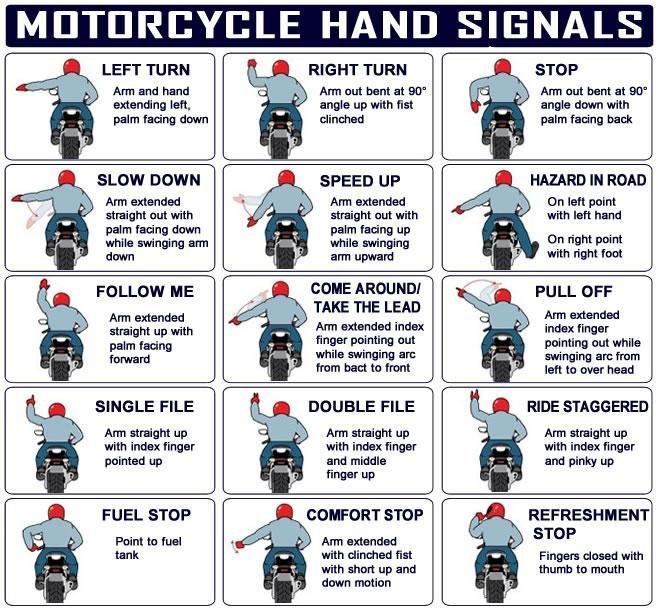
6. Use Hand Signals—and Make Sure Everyone Knows Them
California riders use a pretty standard hand-signal vocabulary:
Slow down
Stop
Hazard in the road
Hazard on the right/left
Single file
Staggered formation
Fuel
Pulling over
Make sure everyone knows the basics. Mixed signals lead to mixed outcomes.
7. Don’t Lane Split as a Group
This is a sensitive topic because lane splitting is legal here and many experienced riders do it comfortably.
But group lane splitting is where everything can go wrong:
Traffic moves unpredictably
Cars don’t expect more than one bike
A sudden stop by the lead rider causes chaos behind
Skill levels vary too much
Escape routes shrink with each additional rider
If riders must split, they should do so one at a time, not as a chain.
8. Keep the Group Size Reasonable
The perfect group size?
4 to 8 riders.
Large groups are fun but much harder to manage:
More spacing issues
More pacing issues
More separation in traffic
More leadership demands
More risk of a multi-bike collision
If you have 20 riders?
Break into two groups.
9. Plan Real Fuel Stops
California has great spots to stop on a motorcycle ride. Every rider has a different tank range. Every bike has different mileage. Every rider’s bladder is on a different schedule.
Running out of fuel in the Sierra passes or on Angeles Crest isn’t an inconvenience, it’s dangerous.
Plan fuel stops. Stick to them. Don’t assume everyone will “figure it out.”
10. Dress for the Slide, Not the Ride
Good group rides can involve:
Debris kicked up by other bikes
Emergency braking
Sudden lean-angle changes
Group-related pileups
Wear all the gear, all the time:
Helmet
Protective jacket
Gloves
Boots
Riding pants
High-visibility or reflective elements
You don’t want to be the rider who shows up in jeans because the weather’s nice, then gets hurt because the group bunches up at a stoplight.
11. Watch the Rider Behind You
This is an old-school touring rule.
On a good group ride, you are always responsible for the rider behind you:
If they fall behind, you slow down.
If you lose sight of them, the group stops.
If they pull over, you pull over.
This keeps the group together without pressure or unsafe pacing.
12. Know What to Do If Someone Crashes
Crashes in group rides often lead to chain reactions. If a rider goes down:
Do NOT stop in the roadway. Move safely out of traffic.
Have at least one person call 911. Provide clear location info.
Establish scene safety. Stop approaching riders, warn traffic.
Don’t remove the rider’s helmet unless breathing is compromised.
Have someone trained in first aid handle immediate care.
Document everything. Photos, video, witness names.
If a car caused the crash, get:
License plate
Driver’s insurance
Photos of the vehicle
Photos of skid marks, debris, bike position
Video of conditions
Do not discuss fault with the driver.
Do not accept apologies as facts.
Let the evidence tell the story later.
What Group Ride Crashes Look Like in Real Cases
After studying many group ride injury and wrongful death cases, you see recurring patterns:
1. Rear-end collisions within the group
Someone brakes suddenly. The rider behind doesn’t see it. The group stacks up.
2. Riders being hit by cars that don’t realize multiple bikes are crossing
Cars often time their turns based on the first rider, not the fourth.
3. Single-bike run-offs caused by pace pressure
A newer rider tries to keep up with a more experienced group.
4. Lane-splitting accidents that take out multiple bikes
A car swerves to open a door or change lanes, hitting one rider and forcing the others to scatter.
5. Crashes caused by debris, gravel, or decreasing-radius turns
What surprises the lead rider is catastrophic for the riders behind.
It only takes one moment, one misjudged corner, one distracted driver, one unexpected hazard, to end a group ride in tragedy.
After a Group Ride Crash: What Riders and Families Should Know
If you’re in a group ride crash in California, the aftermath can be complicated:
Multiple injured riders
Conflicting witness statements
Biker bias in police reports
Arguments about pace, formation, or “riding too close”
Insurance companies trying to blame riders instead of drivers
That’s where experienced motorcycle counsel matters.
A motorcycle lawyer helps by:
Gathering evidence before it disappears
Reconstructing the crash accurately
Protecting riders from unfair assumptions
Identifying the true cause (often a driver—not the group)
Maximizing compensation for injuries
Helping families navigate wrongful death claims
Riders deserve someone who understands the dynamics of motorcycles—and group rides—not someone who thinks you were “just out joyriding.”
The Bottom Line: Group Rides Are Amazing. Just Ride Smart.
Group rides are one of the best parts of motorcycling in California.
They build community.
They build skill.
They build memories that last a lifetime.
And with the right preparation, the right communication, and the right mindset, group rides can also be incredibly safe.
But if something happens, if a driver hits you, if a rider goes down, if a family member is hurt or killed, know this:
You’re not alone. And you don’t have to deal with insurance companies or investigators by yourself.
Our free case evaluations are confidential and go straight to John’s inbox, not a call center. We typically respond the same day.
If you or someone you love was injured on a group ride, reach out.
We know how to ride.
We know how these crashes happen.
And we know how to make sure your story is heard—without judgment, without blame, and without biker stereotypes controlling the outcome.
Your ride. Your rights. Our fight.